
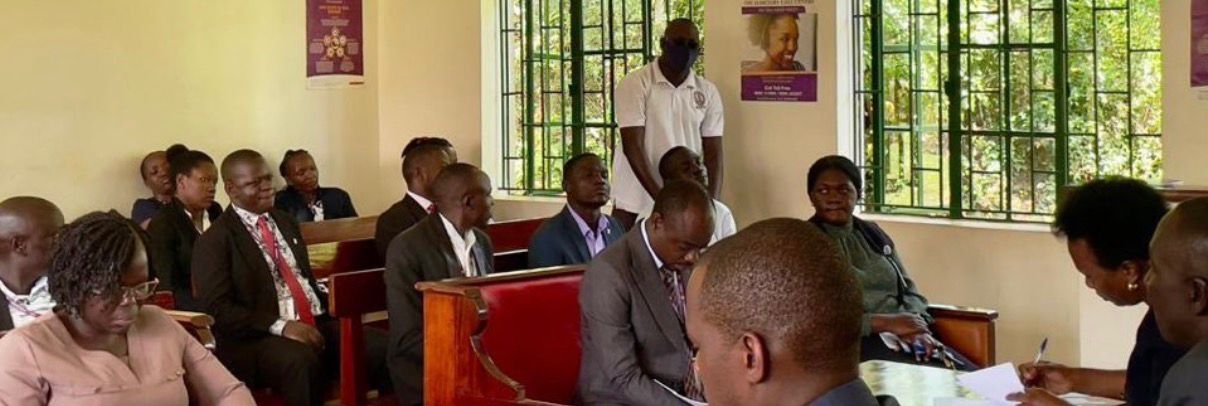
The Hoima High Court Circuit last week convened a Bar‑Bench meeting chaired by the Resident Judge, Justice Vincent Opyene, to review progress in case management, encourage professional conduct, and outline strategic measures to reduce case backlogs.
Justice Opyene opened the meeting by thanking members of the bar for embracing modern approaches to court practice, including online hearings and electronic filing of submissions via the Hoima High Court email address, practices that are permitted under existing law and are designed to expedite judicial processes.
The Resident Judge acknowledged that progress in civil case hearings and judgments had previously stalled due to ongoing High Court criminal sessions but emphasized that this was about to change.
He stated that hearings would now commence at 9:00am and cautioned counsel to file notices of absence in good time.
Failure to do so, he said, could result in the defaulting party being condemned to pay costs for the day. Counsel on a watching brief must also appear with full instructions to proceed.
To further strengthen case disposal performance at the Hoima High Court, Justice Opyene outlined several strategies.
A special session will be convened to hear civil cases that have remained in the court register for more than 10 years. Mediation initiatives will be promoted, including the proposed award of certificates to counsel, law firms, and stakeholders who actively support mediation.
The court will aim to hear approximately 20 bail applications per month to ease congestion, and criminal case files will be scheduled for hearing every other afternoon alongside plea bargain sessions.
“We urge advocates to act professionally, desist from the temptation to pick money in the name of a judicial officer, and beware of court brokers who tarnish the names of lawyers, state attorneys, and judicial officers,” Justice Opyene said.
The Court’s Assistant Registrar, Emmanuel Bamwiite, provided a performance update on case disposal under the leadership of Justice Opyene from 12 March 2025 to 28 March 2026. During this period, the court concluded 124 land cases, 61 civil cases, 70 family causes relating to grant of probate and letters of administration, 189 plea bargains, four mediation case files conducted by the Judge, and 347 criminal case files.
Bamwiite expressed his appreciation to counsel on state briefs for representing the accused in capital case files and reminded advocates that registration for lawyers on state brief was ongoing at his office.
Representing the Attorney General’s Chambers, Counsel Isaac Karekona, Head of the AG’s Chambers in Hoima, informed the meeting that his office is ready to receive service of all case files where the Attorney General is a party. He further proposed a meeting between the Court and AG’s Chambers to discuss mediation and other administrative matters.
Report from the lower courts was delivered by Chief Magistrate George Kunihira, who said he is currently caretaking the Buliisa Chief Magistrate’s Court, with Juliana Kimono also serving in a caretaker capacity. He noted that counsel are now scheduling their High Court cases with due regard to their obligations in lower court matters. He recommended that counsel file notices of instructions for bail and defence in criminal cases to avoid unnecessary adjournments.
Advocates at the meeting raised concerns about congestion at Hoima Prison, proposing that greater use of bail and plea bargain could reduce overcrowding. They also suggested a visit by judicial officers and state attorneys to Hoima Prison after lockdown to assess conditions firsthand.
Other concerns included late starts on criminal case days and requests that counsel who have commitments in other courts be allowed to have their cases called first.
Despite these challenges, advocates commended Justice Opyene for ensuring prompt commencement of hearings at 9:00am, both online and in person, and praised the Chief Magistrates Court registry staff for improvements in the receipt and filing of court pleadings.
In closing, Justice Opyene thanked all members for their candid feedback and assured them that their input would be used to enhance court operations.
